Flu season arrives in Pittsburgh the way winter does. You know it is coming, and it still manages to catch the whole house off guard.
I have spent more than 17 years in nursing, in critical care and home health, and flu season is the stretch I take most seriously. Not because the flu is exotic — because it is ordinary, and ordinary is exactly why people underestimate it. Here is the honest guide I would give a neighbor.
What the flu does to your body
The flu is not a bad cold. It tends to arrive all at once — fever, chills, body aches, and a tiredness that is out of proportion to anything you did that day.
Most of that misery has a plain explanation. Your body raises its temperature to fight the virus, and fever costs you fluid. You sweat. You may vomit, or have no appetite at all, or find that even water tastes wrong.
That is why flu leaves people so depleted. It is not only the virus. It is days of running a deficit.
The shape of a flu week
A typical course looks something like this. The first two or three days are usually the worst — the highest fever, the deepest aches. Around day three or four, the fever often starts to ease. The cough and the tiredness commonly linger into a second week, sometimes longer.
Knowing the shape helps. Feeling awful on day two is the flu being the flu. Getting better and then suddenly worse again is different. That pattern matters.
What genuinely helps at home
There is no shortcut around the flu, but there is real home care, and it is mostly unglamorous.
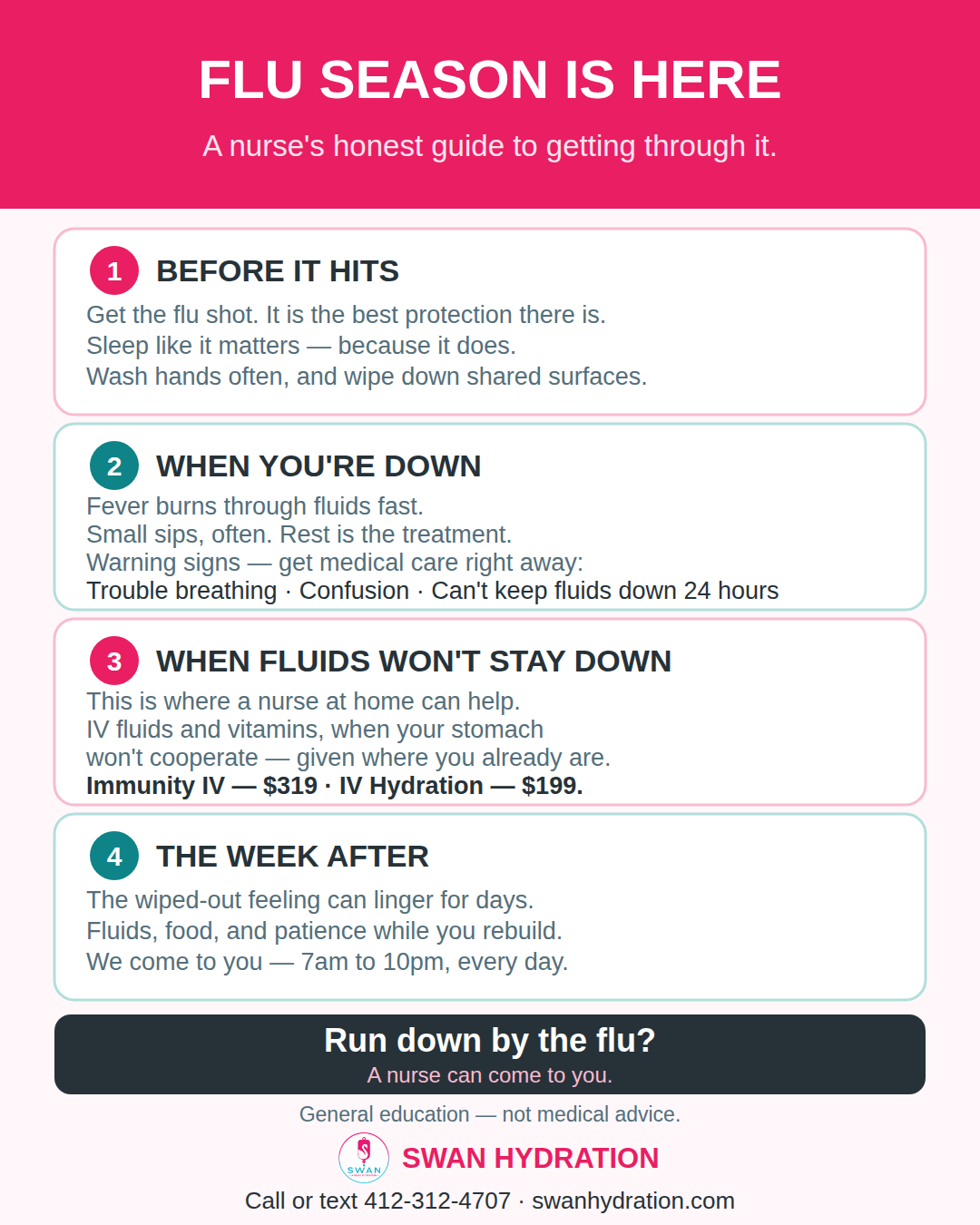
Rest is the treatment. Not rest between errands — actual rest. Fluids matter as much as anything: small, frequent drinks are often easier to keep down than big ones, and water, broth, and oral rehydration drinks all count. Fever reducers like acetaminophen or ibuprofen, used as directed on the label, can make the aches more bearable. Eat what you can, when you can. Soup counts.
Start fluids early, while they are still easy. Waiting until you are badly dehydrated to start drinking is the mistake I see most.
The honest paragraph about Tamiflu
There is medicine that works on the flu virus itself — antivirals, such as Tamiflu. Two things about it are worth knowing. It is time-sensitive: it helps most when started within the first day or two of symptoms, so the time to ask is early. And it is a prescription — it comes from your doctor or an urgent care visit, not from us.
If you are in a higher-risk group — 65 or older, pregnant, living with heart, lung, kidney, or immune conditions — call your doctor at the first sign of flu and ask about antivirals. That phone call is worth more than anything on this page.
Where IV hydration fits — and where it does not
An IV does not treat the flu. It does not kill the virus, shorten the illness, or prevent anything. I would rather lose a booking than have our own website imply otherwise.
What a visit can do is support hydration directly when the flu has run you down and drinking is not catching up — your stomach is unreliable, or you are past the worst of it and still depleted. That is a real, limited, honest use, and it always comes after screening: health history, medications, allergies, a short Good Faith Exam by phone, and a signed consent.
And there are clear lines where the doctor or the ER comes first, not us:
- Trouble breathing, shortness of breath, or chest pain
- Confusion, or trouble staying awake
- Signs of severe dehydration — very little or no urination, a racing heartbeat, strong dizziness when you stand
- Symptoms that improve, then get worse again — that pattern can mean a second infection settling in, and it needs a clinician's eyes
- Anyone at higher risk, early in the illness, as above
If you are not sure which side of the line you are on, err toward the doctor. We would rather hear it was nothing.
Get the flu shot
I will say this plainly, even though we do not sell it: the single best protection against the flu is the flu shot. It is not perfect. It still lowers your odds of catching the flu and of ending up seriously ill if you do.
A nurse who only recommends what she can bill you for is a salesperson. Get the shot.
Not sure where to go for one? Our flu season page rounds up the finder tools and pharmacy schedulers: swanhydration.com/flu-season (https://www.swanhydration.com/flu-season)
The bottom line
Treat the flu with respect, rest like it is your job, start fluids early, and ask your doctor about antivirals early if you are at higher risk. If you are past the worst and still running on empty, a nurse at your kitchen table may be reasonable support — and we will tell you honestly if it is not.
We serve the Pittsburgh area — Allegheny, Washington, Beaver, Butler, Westmoreland, Fayette, and Greene counties — 7am to 10pm, every day. Call or text us at 412-312-4707 and tell us how you are feeling. We will help you sort out what you actually need, even when the answer is not us.
General education — not medical advice.
By Mercedes Denham, RN, BSN — Founder, Swan Hydration