By Mercedes Denham, RN — Swan Hydration, Pittsburgh
What the Research Says — a Swan Hydration series on the published evidence behind what we do
If you spend any time looking at IV therapy online, you will see big promises. More energy. Stronger immunity. Faster recovery. A reset in under an hour.
I am a nurse, and this is the business I built — so let me be plain about what the published research actually supports, what it only hints at, and what it does not show at all. I would rather you trust us for our honesty than book because of a claim I cannot back up.
First, what IV fluids are genuinely established for
IV fluids are ordinary, essential medicine. When a person cannot keep fluids down, or losses are outrunning what they can drink, a vein is a reliable route.
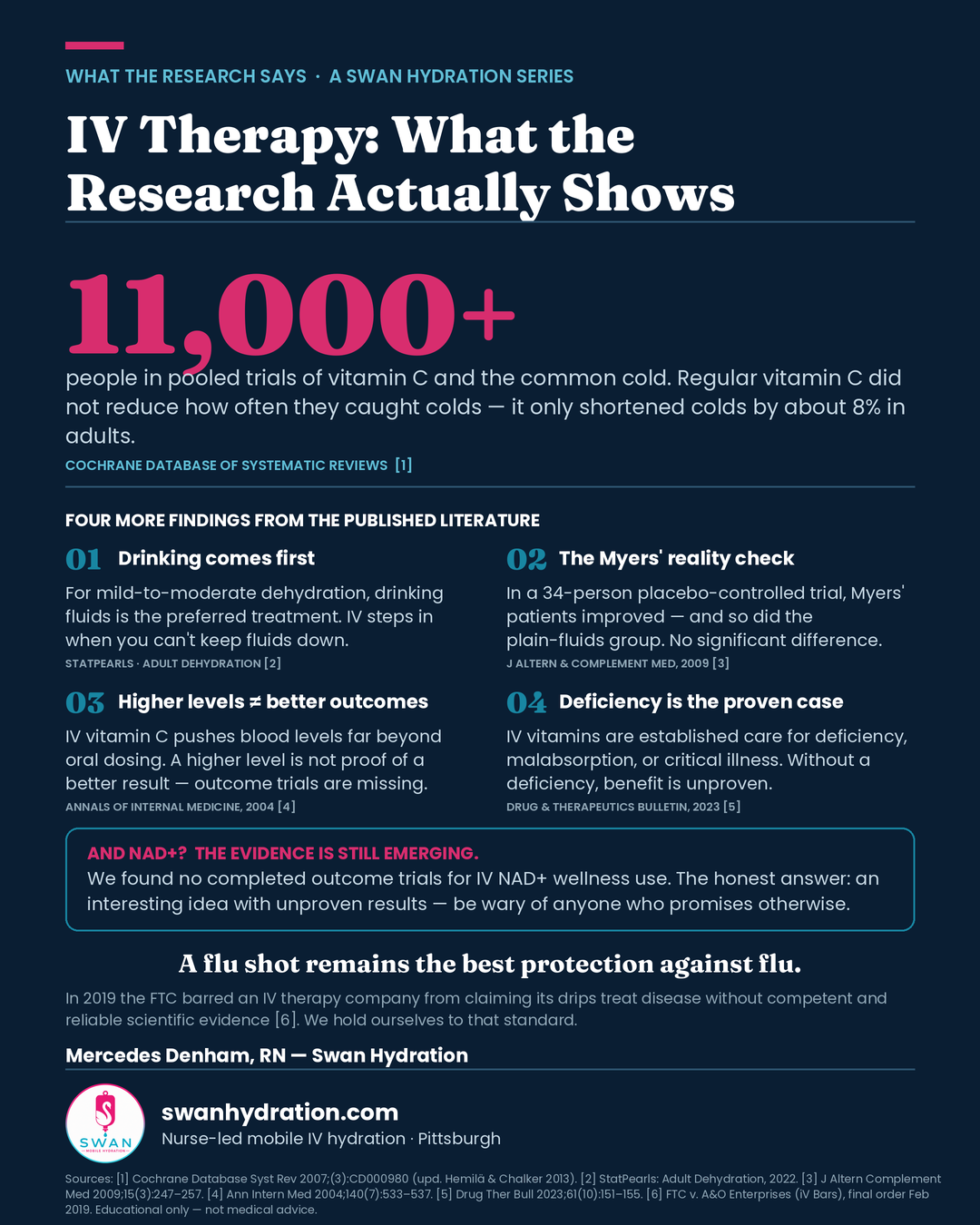
The clinical reference StatPearls, in its review of adult dehydration, puts the order of things clearly: "Oral rehydration therapy (ORT) is the preferred treatment for mild-to-moderate dehydration if the patient can tolerate oral intake." Drinking comes first — that is the honest starting point, and any nurse who tells you otherwise is selling, not treating.
The same review explains where IV belongs: "When a patient presents with severe dehydration or cannot tolerate ORT, intravenous fluid therapy is necessary to restore fluid balance and correct electrolyte disturbances rapidly." [1]
So the established job of an IV is straightforward: replace fluid and electrolytes when the mouth cannot, or cannot keep up. Most people we see are not emergencies — they are depleted, nauseated, and struggling to catch up by drinking. IV hydration supports that recovery. It does not do magic on top of it.
Correcting a real deficiency is established medicine, too
Vitamins are not fairy dust; they are nutrients your body genuinely needs, and when a level is truly low, replacing it matters.
A 2023 review in the Drug and Therapeutics Bulletin — a publication known for being hard-nosed about evidence — separates this cleanly. Intravenous vitamins have real medical uses, it notes, for conditions such as "malabsorption syndromes with severe vitamin depletion, Wernicke's encephalopathy or critical illness." In other words: when there is a documented deficiency, or the gut cannot absorb what it needs, delivering a nutrient by vein is standard, sensible care. [2]
The flip side of that same review is the part our industry quotes less often:
"There is a lack of high-quality evidence to suggest that high-dose vitamin infusions are necessary or offer any health benefit in the absence of a specific vitamin deficiency or medical condition." [2]
Read that twice, because it is the honest center of this whole topic. Deficiency? Repletion is evidence-based. No deficiency? The benefit of large IV doses is unproven — not disproven in every case, but unproven.
What about the famous Myers' Cocktail?
The best-known formula in this field traces back to one physician's clinical experience. In 2002, Dr. Alan Gaby published a paper describing a modified version of Dr. John Myers' intravenous mix of magnesium, calcium, B vitamins, and vitamin C, along with his own years of using it in practice. [3] That paper is one clinician's experience — valuable as experience, but not a trial: nobody was randomized, and there was no placebo or comparison group.
When researchers finally ran that comparison, the result was humbling for everyone. In a randomized, double-blind, placebo-controlled pilot study of 34 adults with fibromyalgia, people getting the Myers' Cocktail improved — and so did people getting plain lactated Ringer's solution. The authors found "no statistically significant differences were seen between groups, in any outcome measure," and concluded: "The efficacy of IVMT for fibromyalgia, relative to placebo, is as yet uncertain." [4]
Thirty-four people is a small study. It does not prove the cocktail does nothing. It does prove that feeling better after a drip is not, by itself, proof the vitamins caused it — rest, fluids, time, care, and expectation are powerful, and they were all in the room.
"But doesn't IV at least absorb better?"
For vitamin C, the pharmacology is real. A well-known NIH study found that "oral vitamin C produces plasma concentrations that are tightly controlled," while IV dosing can push blood levels far higher. [5]
But a higher blood level is not the same as a better outcome. It does not, by itself, show prevention, restored energy, or a shorter illness. Those need outcome trials — which, for most wellness uses, are still missing.
The immunity claim, checked against the biggest review we have
Vitamin C is the ingredient most often sold with immunity language, so it deserves a direct look. The most thorough summary is a Cochrane review — the kind of analysis that pools every quality trial it can find. Across trials involving more than 11,000 participants, regular oral vitamin C did not reduce how often ordinary people caught colds. Its authors concluded: "The failure of vitamin C supplementation to reduce the incidence of colds in the normal population indicates that routine mega-dose prophylaxis is not rationally justified for community use." Regular use did modestly shorten colds people caught anyway — about 8% in adults. [6]
That is oral vitamin C, studied hard for decades. If that is the strongest immunity evidence for the best-studied ingredient we have, you can see why we never promise a drip will keep you from getting sick.
Why we are careful with our words
This is not just our preference; it is the law of honest advertising. In 2018, the Federal Trade Commission brought its first case against an IV cocktail company that had marketed drips as treatments for serious diseases. The final order barred such claims "unless they can be supported by competent and reliable scientific evidence." [7]
We take that standard as our own. When we say a drip supports hydration, that is something we can stand behind. When a benefit rests on small studies, clinician experience, or a plausible mechanism, we will say exactly that — and when the evidence is not there, we will say that too.
How we practice, given all of this
Because an IV is a real medical procedure, we treat it like one. Our work follows the Infusion Therapy Standards of Practice published by the Infusion Nurses Society — the evidence-based standards governing patient selection, infection prevention, and safe administration, including a dedicated standard for home infusion care like ours. [8]
Swan Hydration is nurse-led, with physician oversight. Every visit starts with screening and a Good Faith Exam, because the right first question is never "which drip?" — it is "is a drip appropriate for you at all?" Sometimes the honest answer is rest and a glass of water. We would rather tell you that than sell you something the research cannot support.
— Mercedes Denham, RN, Founder, Swan Hydration
Sources
- Taylor K, Jones EB. Adult Dehydration. In: StatPearls [Internet]. Treasure Island (FL): StatPearls Publishing; updated October 3, 2022. NCBI Bookshelf ID: NBK555956. https://www.ncbi.nlm.nih.gov/books/NBK555956/
- Intravenous vitamin injections: where is the evidence? Drug and Therapeutics Bulletin. 2023;61(10):151–155. PMID: 37640530. https://www.medscape.com/medline/abstract/37640530 (abstract via PubMed/MEDLINE)
- Gaby AR. Intravenous nutrient therapy: the "Myers' cocktail." Alternative Medicine Review. 2002;7(5):389–403. PMID: 12410623. https://pubmed.ncbi.nlm.nih.gov/12410623/
- Ali A, Njike VY, Northrup V, Sabina AB, Williams A-L, Liberti LS, Perlman AI, Adelson H, Katz DL. Intravenous micronutrient therapy (Myers' Cocktail) for fibromyalgia: a placebo-controlled pilot study. Journal of Alternative and Complementary Medicine. 2009;15(3):247–257. DOI: 10.1089/acm.2008.0410. https://pubmed.ncbi.nlm.nih.gov/19250003/
- Padayatty SJ, Sun H, Wang Y, Riordan HD, Hewitt SM, Katz A, Wesley RA, Levine M. Vitamin C pharmacokinetics: implications for oral and intravenous use. Annals of Internal Medicine. 2004;140(7):533–537. DOI: 10.7326/0003-4819-140-7-200404060-00010. https://pubmed.ncbi.nlm.nih.gov/15068981/
- Douglas RM, Hemilä H, Chalker E, Treacy B. Vitamin C for preventing and treating the common cold. Cochrane Database of Systematic Reviews. 2007;(3):CD000980. DOI: 10.1002/14651858.CD000980.pub3. https://pubmed.ncbi.nlm.nih.gov/17636648/ (Updated by Hemilä H, Chalker E. 2013;(1):CD000980. DOI: 10.1002/14651858.CD000980.pub4.)
- Federal Trade Commission. FTC Approves Final Consent Order Against Company and Owner Who Allegedly Made Unsupported Health Claims for Intravenously Injected Therapy Products (A & O Enterprises Inc., d/b/a iV Bars). Press release, February 2019 (complaint announced September 2018). https://www.ftc.gov/news-events/news/press-releases/2019/02/ftc-approves-final-consent-order-against-company-owner-who-allegedly-made-unsupported-health-claims
- Nickel B, Gorski L, Kleidon T, Kyes A, DeVries M, Keogh S, Meyer B, Sarver MJ, Crickman R, Ong J, Clare S, Hagle ME. Infusion Therapy Standards of Practice, 9th Edition. Journal of Infusion Nursing. 2024;47(1S Suppl 1):S1–S285. DOI: 10.1097/NAN.0000000000000532. PMID: 38211609. Publisher: Infusion Nurses Society — https://www.ins1.org