By Mercedes Denham, RN, BSN — Founder, Swan Hydration
I run a mobile IV business, so you might expect this post to end with "and that's why you should book." It won't — because the honest answer starts with this: most days, for most people, a glass of water is the right call.
Here’s the real difference between the two, so you can decide for yourself.
What happens when you drink water
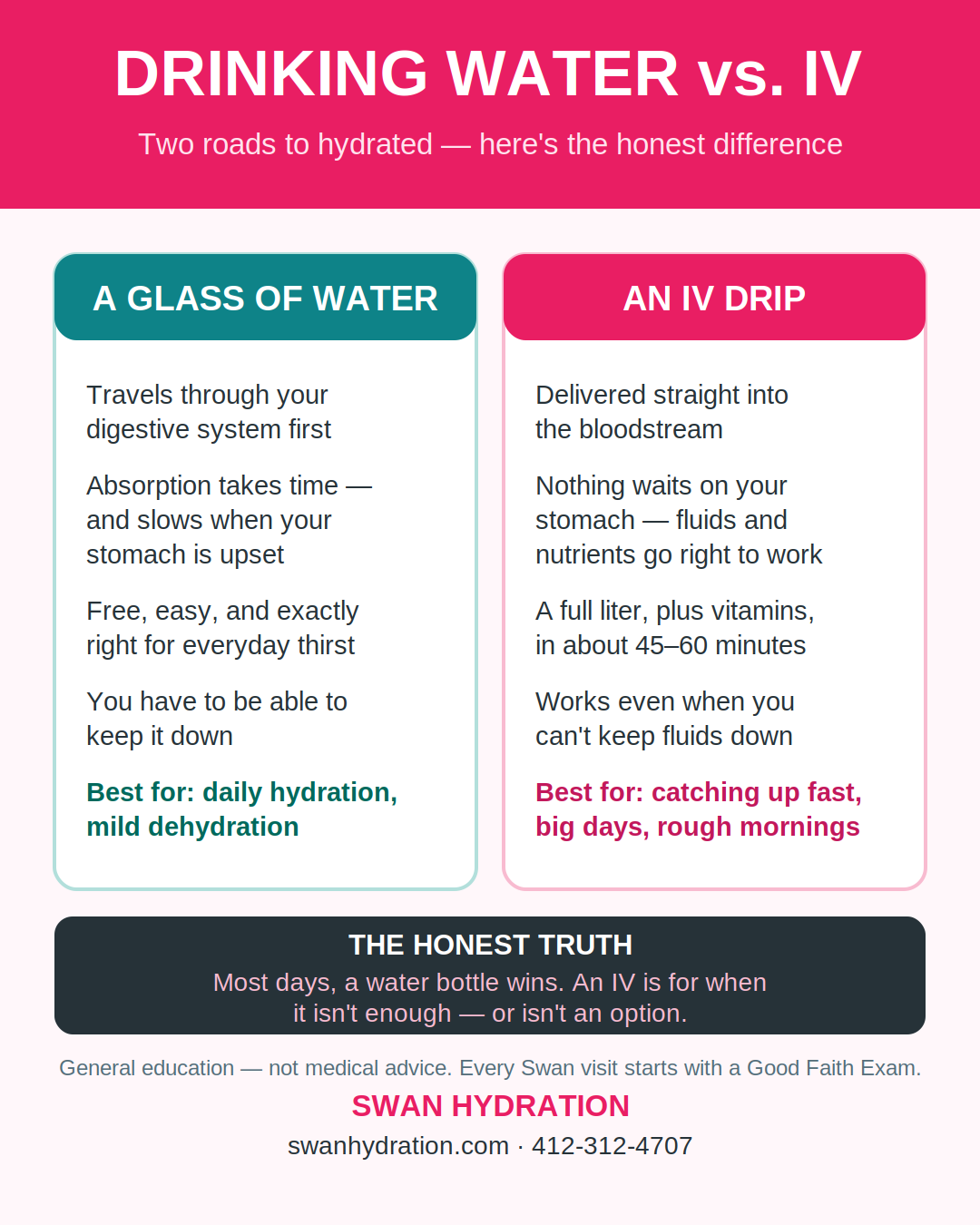
It travels through your digestive system first. Your stomach and intestines absorb it over time — and that system slows down exactly when you need it most: when you're nauseated, when you've been sick, when your stomach is in no mood to cooperate. Water is free, it's easy, and for everyday thirst and mild dehydration, it's exactly right. You just have to be able to keep it down, and give it time.
What happens with an IV
Fluids go straight into the bloodstream through a vein. Nothing waits on your stomach. A full liter of saline — with vitamins, if your provider includes them — is in over about 45 to 60 minutes, and it works even when drinking isn't going well.
That’s the whole difference. Speed and route. Not magic.
When drinking wins
Daily hydration. A mild headache. The afternoon slump. After a normal workout. If a glass or two of water and a little time fix it, that's your answer, and it costs nothing. We mean that — our own dehydration guide tells you to start with water.
When an IV makes sense
When you can't keep fluids down. When you're behind and need to catch up faster than your stomach allows. Before or after a big day — a race, a wedding, a long shift, a red-eye — when "eventually hydrated" isn't the same as hydrated in time.
The part nobody should skip
An IV is a medical procedure, even a comfortable one on your couch. That's why every Swan visit starts with a Good Faith Exam by a licensed provider, and why the person starting your IV is a registered nurse. If a provider ever tells you a drip is no different from a sports drink, find a different provider.
Drink your water. And when water isn’t enough — or isn’t an option — that’s what we’re here for.
General education, not medical advice.