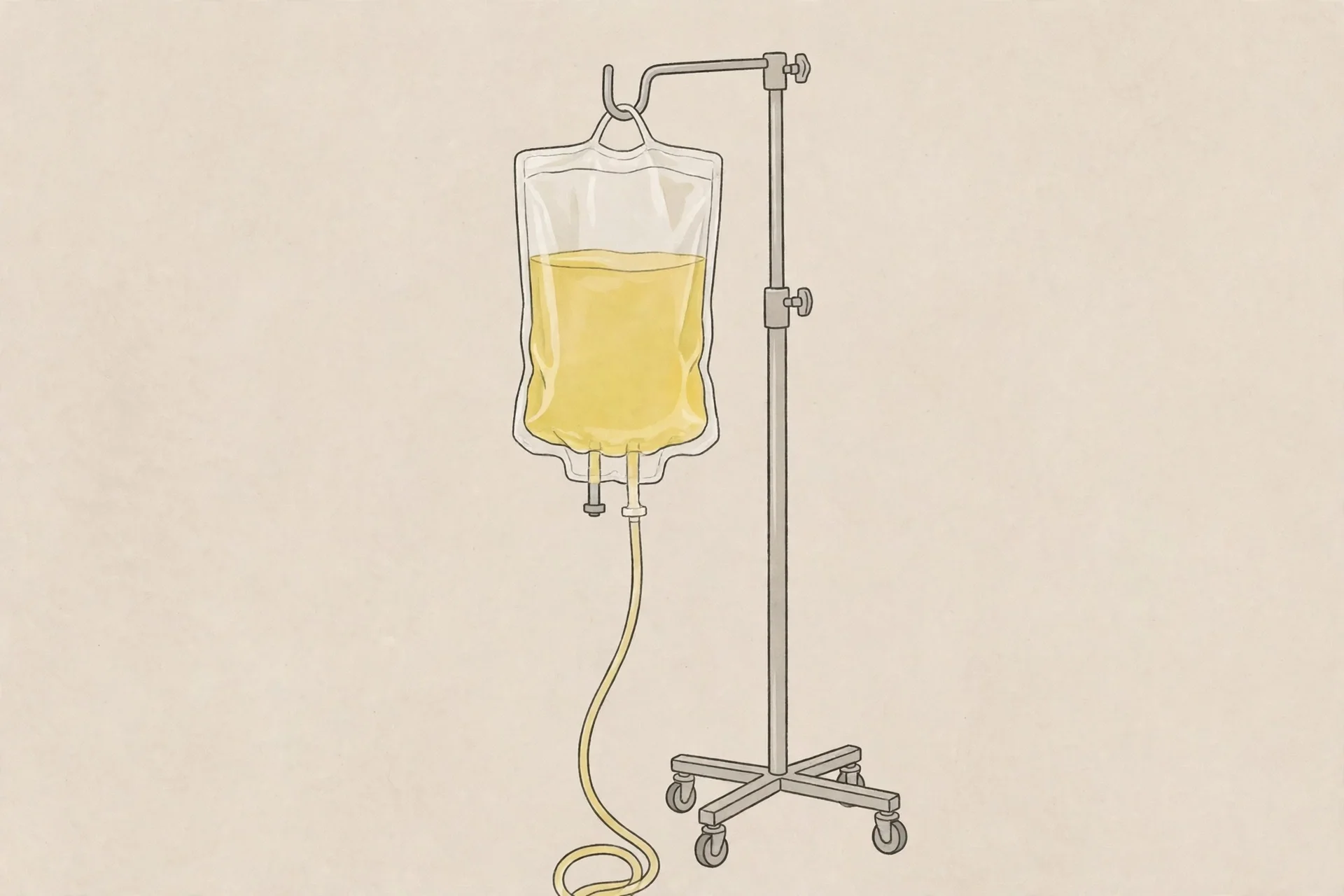
If you have ever been treated in a hospital, or sat with someone who was, you may have noticed a bag of IV fluid that was bright yellow. Nurses call it a banana bag. The name is not official, but it has stuck for decades, mostly because the bag really is the color of a banana.
So what is in it, and why do hospitals hang it? I get asked this more often than you might think.
What a banana bag actually is
A banana bag is a bag of IV fluids — usually a liter of saline or a similar solution — mixed with vitamins. The classic recipe includes a multivitamin, B-complex vitamins, thiamine (vitamin B1), and folic acid. Some hospitals add magnesium as well.
The yellow color comes from the B vitamins. That is the whole mystery. There is no banana in it.
Why hospitals use it
The banana bag is supportive care. Hospitals reach for it when someone is dehydrated and also low on vitamins — after a long illness, after days of vomiting, when someone has not been eating well, or when alcohol use has depleted the body's stores of thiamine and folate. Replacing fluids and those vitamins at the same time is efficient, and for a depleted patient, it matters.
What it is not is a cure for anything. It does not treat the infection, the stomach bug, or the underlying problem. It supports the body while the real treatment — or time, rest, and food — does its work. A nurse should be honest about that distinction, and I will be too.
Can you get something like it at home?
For a true emergency, no. I will come back to that, because it is the most important part of this post.
But many people who go looking for a banana bag are not in an emergency. They are home, run down, and behind on fluids after an illness or a long weekend, wondering whether they really need to spend hours in an emergency department for fluids and vitamins.
That is where a mobile visit can make sense. At Swan Hydration, we come to your home, your workplace, or your hotel across the Pittsburgh area. Our IV Hydration visit (https://www.swanhydration.com/appointments) ($199) is IV fluids, and vitamins such as B-complex and B12 can be part of a visit depending on your health history. You can see what goes into each drip on our IV menu (https://www.swanhydration.com/ivmenu-content).
I want to be precise here: a home visit is not a hospital banana bag, and I would not call it one. It covers similar ground — fluids plus vitamin support — for people who are stable, screened, and safe to care for at home.
Every Swan visit starts the same careful way. We review your health history, your medications, and your allergies. You complete a short Good Faith Exam by phone, about five minutes, and you sign a consent form before we begin. If anything in that screening tells us you need a higher level of care, we will say so and point you to it. That is not a failed visit. That is the system working.
When the answer is the emergency department, not us
Please read this part twice. Call 911 or go to the ER if you have:
- Chest pain or trouble breathing
- Confusion, fainting, or trouble staying awake
- Vomiting blood, or vomit that looks like coffee grounds
- Signs of severe dehydration — very little or no urination, a racing heartbeat, strong dizziness when you stand
- An inability to keep any fluids down for 24 hours
- A high fever, severe abdominal pain, or symptoms that are getting worse instead of better
A home IV visit is for people who are uncomfortable. It is not for people who are in danger. If you are not sure which one you are, err on the side of the ER. We would rather lose a booking than have you lose time you needed.
The simple version
A banana bag is fluids plus vitamins, used in hospitals for people who are dehydrated and depleted. If you are stable and simply behind — on fluids, on rest, on taking care of yourself — a nurse at your kitchen table may be the right level of help. We serve Allegheny, Washington, Beaver, Butler, Westmoreland, Fayette, and Greene counties, 7am to 10pm, every day.
You do not have to figure out which category you fall into alone. Call or text us at 412-312-4707, tell us what is going on, and we will help you sort it out honestly — even if the honest answer is the emergency department.
General education — not medical advice.
By Mercedes Denham, RN, BSN — Founder, Swan Hydration